As a new graduate student at Syracuse University, I wanted to create a blog where I can express my ideas, opinions and findings throughout the program in order to start a discussion with others in my field of study. For my inaugural blog post, I will be discussing a few aspects of mass communication and how they relate to current societal or cultural practices and phenomena.
The first media and culture topic I’d like to discuss is selective exposure. Selective exposure is the way in which we consciously or subconsciously choose to view media outlets that directly align with our own personal values or interests. This occurs most often when choosing which political outlets to view. Whether your political values align with the left or right, you are most likely going to follow a news site which is known for discussing the same or similar views as you. In addition to this, we respond to storytelling techniques and audience responses to help round our opinions on the matter. So what are the implications of selective exposure? The internet has become somewhat of an information free-for-all due to its democratic nature. Anyone can be a “sender” or a “receiver” of information by posting their own videos, comments, or articles online. There are almost no gatekeepers (editors) making sure what you’re saying is factual or beneficial to society, so the things you say and post can essentially be limitless. Some may value this openness, while others may prefer to see more editing and structure in the information they are receiving. One example of this preference is the presidential race between Hillary Clinton and Donald Trump. Clinton’s campaign was arguably a more controlled, planned, and traditional campaign than Trump’s for a few reasons, one being that Clinton used ad campaigns on major news channels and websites to spread her message, while Trump spent virtually nothing on ad campaigns (except towards the end of his campaign) and instead relied on his narrative skills, TV persona, and personal Twitter account to speak candidly with audiences about his dislike for certain people, groups and legislation. His supporters praised how “real” he was, while those who were not in agreeance with him and his campaigning methods considered his acts unpresidential.
Besides this past presidential race, another example is influencers. We follow certain youtubers, bloggers, and celebrities for the exact same reason we follow certain news outlets. We identify on some level with influencers or celebrities whether we may realize it or not, through shared hobbies, fashion sense, humor, values, or lifestyle choices.
The next topic I’d like to discuss is the stages in which media innovations go through. The four stages are the emergence (or novelty) stage, the entrepreneurial stage, the mass medium stage, and the convergence stage. In the emergence stage, we see inventors trying to solve a particular problem. They see a gap in the market for a specific service or invention and decide to fill this gap. During the entrepreneurial stage is where these inventors or investors meet to discuss ways to make this new invention practical and marketable for particular audiences. Next, comes the mass medium stage which is when business teams figure out the marketing logistics to make their product or service a consumer product. The final stage is the convergence stage where old and new media used or created by this business are brought together to spread the desired messages of the company. This could include lead generators, videos, giveaway items, downloadable items, infographics, PR/marketing campaigns etc. However, I have a few thoughts on this linear process. Does it only work if it is done in this exact order? Do these steps get muddled together more often than not? The correct answer (in my opinion) to these questions isn’t a firm yes or no, but that the guidelines are merely a suggestion. I believe that this is a great guideline to follow loosely, but the path to success is different for everyone and whether your business is following these steps or not proves that success must be measured on a case to case basis rather than by one all encompassing method.
For a little under a year, I worked at a start-up company and from personal experience, plans never followed these four stages exactly. On occasion, we would find ourselves in the convergence stage, come up with a new idea for our service or another way to market ourselves, and bring everything back to the entrepreneurial stage. Every day was different and our goals were constantly changing. My key takeaway here is that these steps are great to follow in order to keep your business organized and keep team members on the same page, but don’t let it discourage you or your team from jumping on a new idea or business opportunity.
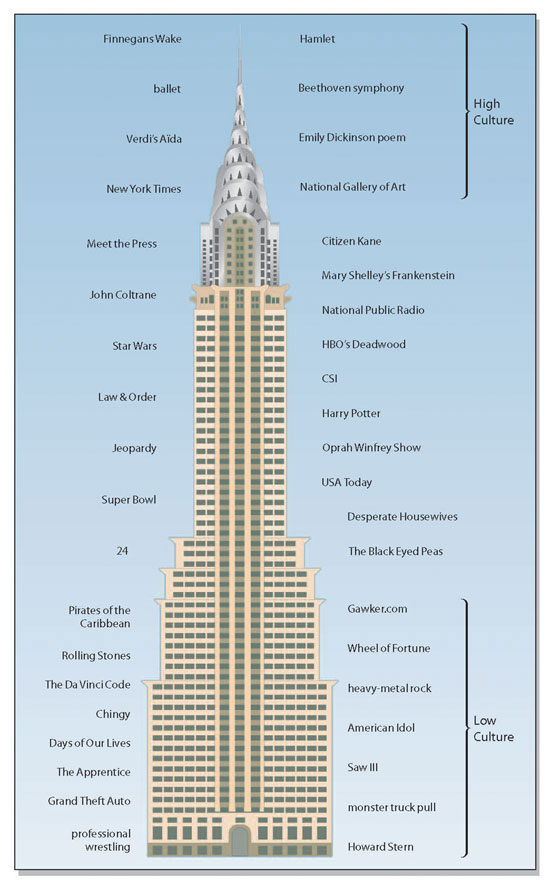
The last topic I would like to discuss is culture organized by the skyscraper model pictured below. The skyscraper model was created to categorize certain things that are regarded as high, middle or low culture items and it really stuck with me/got me to think. As you may have guessed, at the top of the skyscraper model are items listed as high culture, such as ballet, fine art, and classic literature. At the bottom of the skyscraper are items listed as low culture, such as online gossip columns and reality television. One question that was asked in my Digital Communications class is “Why are some items considered high or low culture and who controls this process?” I believe that the answer to this is cultural values and norms that are reflective of the time period. I realized that high culture items were things that were well thought out, expertly crafted, had deeper meaning, and were made to benefit society in some way. Low culture items are more often than not just spoofs of these high culture items and are created to serve as more obtainable or “easier to understand” versions of high culture items. My favorite example of this is Mary Wollstonecraft Shelley’s iconic book Frankenstein. Shelley is well-known for shedding light on cultural, societal and political issues in her books, Frankenstein being no exception. Frankenstein emphasizes themes of the misuse and abuse of science as well as judging people for things that they can not control such as their looks. Over the years, this book has been recreated as a sci-fi movie (I Frankenstein), a comedy (Young Frankenstein), a sitcom (The Munsters) and even a child’s cereal (Franken Berry). These deeper meanings seen in Shelly’s book become exploited and lost in favor of simplistic low culture entertainment and serve as a means of learning the overall big picture of a classic story, but in a dumbed down way.
 .
.
What are your opinions on selective exposure, the skyscraper model and media innovation stages?

 stephmt.com